

HenleyPrimary School

Our family of schools
-

Barnby and North Cove Primary School
-

Glebeland Primary School
-

Helmingham Primary School and Nursery
-

Kirkley Nursery
-

Mendham Primary School
-

Middleton Primary School
-

Reedham Primary School
-

Rendlesham Primary School
-

Southwold Primary School
-

St Edmund's Primary School
-

Warren School
-

Henley Primary School
-

Yoxford & Peasenhall Primary Academy
-

Winterton Primary School and Nursery
-

Riverwalk School


Attendance
Regular school attendance enables children to maximise the educational opportunities available to them. Excellent attendance helps children to become emotionally resilient, confident and competent adults who are able to realise their full potential and make a positive contribution to their community.
Henley Primary School values all children. We work with families to identify the barriers to achieving and maintaining excellent attendance and offer the right services, at the right time, to resolve difficulties.
Attendance concerns will be raised with parents (when reasons are not known by the school, e.g. recovery from an operation). This information may also be shared with Suffolk County Council. Where we have concerns, or there is a lack of engagement from families to improve attendance, we will follow the school’s staged approach to improving attendance.
Our graduated approach is child-centred and prioritises support and developing strong working relationships with families. We will use the Early Help process to provide support prior to escalation and consider how we can work with families to enable children to access their right to education.
An attendance summary will be shared with all parents each half-term. Parents can also access their child’s live attendance figure, at any time, through the Arbor app.
At Henley Primary School, we maintain and promote good attendance and punctuality through:
• Raising awareness of attendance and punctuality issues among all staff, parents and pupils.
• Ensuring that parents understand the responsibility placed on them for making sure their pupil attends regularly and punctually.
• Provide parents with accurate, real-time attendance data via the Arbor website.
• Equipping pupils with the life skills needed to take responsibility for good school attendance and punctuality appropriate to the child’s age and development.
• Maintaining effective means of communication with parents, pupils, staff and Trust Board on school attendance matters.
• Developing and implementing procedures for identifying, reporting and reviewing cases of poor attendance and persistent lateness.
• Supporting pupils who have been experiencing any difficulties at home or at school which are preventing good attendance by identifying barriers to school and developing strategies to overcome these.
• Developing and implementing procedures to follow up non-attendance at school.
Graduated Plan:
Where a child’s attendance record does not improve over a period the following process will take place:
• 95% letter to inform parents of attendance
• 92% if no improvement following the 95% letter
• Parents to attend meeting to discuss attendance
• Attendance action plan with parents/carers (4 weeks)
• Review action plan
• No improvement - legal interventions
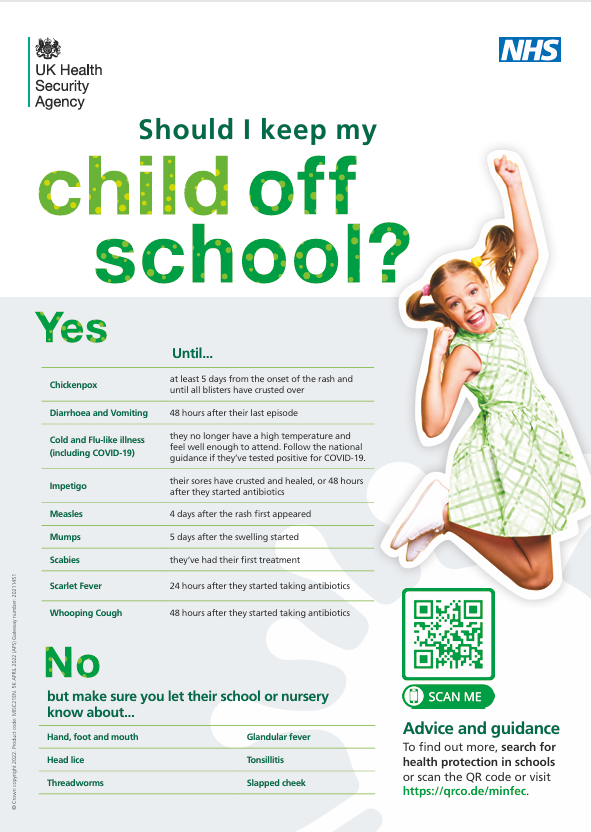
When should I keep my child off school?
|
AVOIDABLE ABSENCE IN TERM TIME |
|
|
The Facts |
The Law |
|
School aged pupils in are expected to attend punctually on the 190 days that the school is open. Whilst there are a number of unavoidable reasons why a pupil might be away from school (illness, medical appointments, exclusions etc.) the legislation is clear that any avoidable absence may only be authorised by a school if there are exceptional circumstances. WHAT YOU SHOULD CONSIDER Research suggests that children who are taken out of school may never catch up on the learning they have missed. This may affect test results and can be particularly harmful if the child is studying for final year examinations. Children who struggle with English or Mathematics may also find it even harder to cope when they return to school, while younger children may find it difficult to renew friendships with their classmates. If the school is unable to authorise the absence and the child is still taken out of school, this will be recorded as unauthorised absence and you may receive a £80* fine per parent per child if your child’s attendance is deemed to be “not regular”, falling below the threshold of 96% |
The law allows the school to consider individual requests to authorise a future avoidable absence. However, before the school can authorise any such requests, they must satisfy themselves that there are exceptional circumstances which justify such a decision. It is entirely the responsibility of the parent submitting the request to provide sufficient evidence/information in order to establish this fact. The request for leave must come from the parent with whom the child normally resides. If a child then stays away from school for more than the authorised period this must be recorded as unauthorised absence and could be quoted in a prosecution for poor attendance. If the child is away for a period of four weeks or more, the school may have the option to take the child off roll subject to the Education (Pupil Registration) (England) Regulations 2006 In case of unexpected extended absence, it is advisable that the parent fully informs the school as to the reasons. If a child is removed from roll, there is no guarantee that the child will regain a place at the school. |
|
Unavoidable absence from school will be authorised. Examples include:
|
Other examples of absence from school that will not be authorised include:
|
Where can I access support?
Where can I access support?